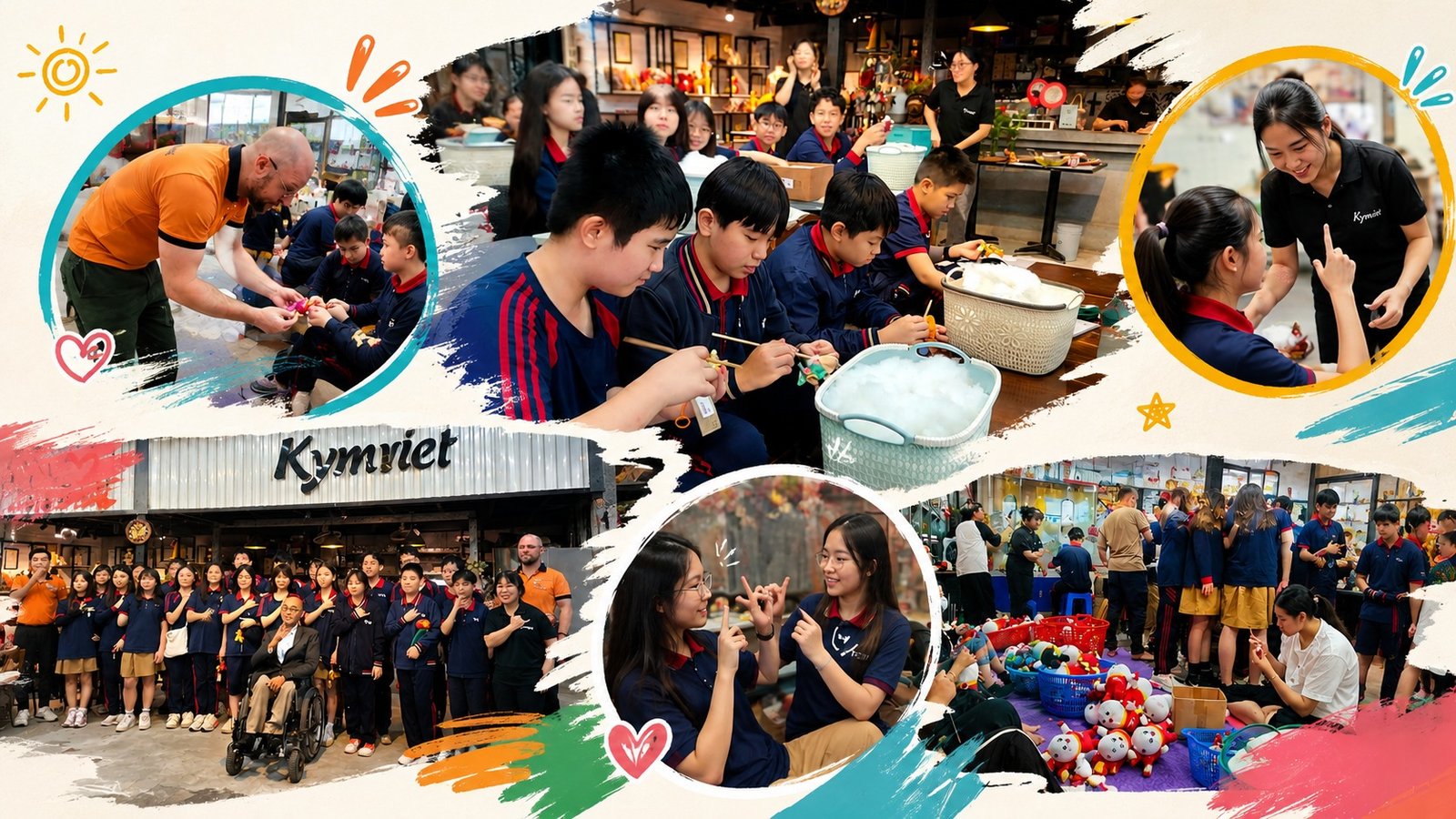
When a handmade product is created, there is a whole process behind it: from idea, fabric selection, cutting, sewing to finishing. But few notice that in a workshop, people can collaborate in many ways, not just through speech. A field trip to a craft workshop for students can open up interesting observations about the craft, about skill, and about how people communicate.
This article is for teachers, extracurricular activity coordinators, and school administrators, helping them envision a day of experience at the Kym Viet craft workshop in Hanoi and what to prepare before organizing it.
Why can a craft workshop become an outdoor learning space?
A craft workshop is not just a production place, but also a learning environment rich in material. Students can observe how a product is made from raw materials, follow each step, and see the coordination among workshop members. This helps them better understand real working processes, something that books cannot fully convey.
The trip is positioned as an outdoor educational activity with learning objectives, not a charity event or a disability simulation program. The focus is on observing the craft, understanding processes, practicing a suitable step, and learning about coordination in the workshop. Through this, students have the opportunity to develop focus, patience, and respect for differences in communication.
What activities are planned for students?
The field trip program to the craft workshop for students is expected to include activities designed with learning objectives. Below are the main contents that students can participate in, noting that specific details will be confirmed when the school contacts us.
Tour the workspace
Students will walk through different areas of the workshop, from material storage, cutting and sewing areas to the finishing area. Observing the real workspace helps them understand how a production workshop is organized, the role of each area, and the movement of materials through the steps.
This is also an opportunity for students to realize that a handmade product is not just an object, but the result of many steps, many hands, and meticulousness. The workshop space with fabric, thread, and stuffing will spark curiosity and questions.
Observe the craft process
Students will observe artisans performing steps such as cutting fabric, sewing, stuffing, and finishing products. Seeing a product being created by skilled hands will help them appreciate the value of labor and understand the patience required in the craft.
Through observation, students can notice small details like stitches, color coordination, and how corners are handled. These are practical knowledge that no classroom lesson can convey as vividly as witnessing it firsthand.
Practice a suitable step
Hands-on practice is an important part of the trip. Students will be guided to perform a simple step, suitable for their age, with the support of artisans. Making a small product with their own hands will bring excitement and help them understand the focus and meticulousness required.
This activity not only trains manual skills but also helps students feel the joy of completing a product. However, the specific content of the practice, as well as whether students can take the product home, will be confirmed when the school registers.
Get familiar with communication at the workshop
A special feature of the Kym Viet workshop is the working environment with many Deaf artisans. Students will have the opportunity to get familiar with sign language communication, a form of communication without speech. This helps them broaden their understanding of the diversity of human communication.
This introduction is integrated naturally, not as a formal sign language lesson. Students can learn a few simple signs, understand how Deaf people exchange information, and feel that communication is not only through words. Specific content of this part will be confirmed when the school contacts us.
The role of artisans in the experience
In the field trip, artisans play the role of craftspeople and professional instructors. They are skilled, knowledgeable about production processes, and able to convey knowledge to students. The introduction of artisans focuses on their techniques, the steps they are responsible for, and how they coordinate in work, rather than emphasizing their disabilities.
Students will see professional, meticulous workers who are responsible for their products. This helps them have a respectful and normalized view of differences, while learning the spirit of hard work. Deaf artisans are introduced like any skilled craftsman, with an emphasis on their craftsmanship and dexterity.
What should the school prepare before the trip?
To ensure a smooth field trip, the school needs to consider some organizational issues. First, determine the age and number of participating students, and prepare accompanying teachers and safety measures accordingly. It is also necessary to communicate rules and regulations about photography and filming before the trip.
Additionally, the school should discuss with the organizing unit about the workshop’s accessibility, any special requirements, and agree on the use of student images. Thorough preparation will help the experience be safe, effective, and aligned with educational goals.
Information to know before booking
Kym Viet is a social enterprise operating in the field of fabric handicraft production, established in 2013. The workshop is located at 123 Trung Van, Dai Mo, Hanoi. The experience program for schools is named K001, with a duration of 150 minutes, including 7 activities. Operating days are Monday to Saturday, and booking is required at least 3 working days in advance; groups over 30 people are recommended to book 5-7 days ahead.
Group size can range from 1 to 100+ guests; groups over 50 will be divided into parallel sessions. Costs are quoted per group, with no fixed price list. Included are 8% VAT, water, snacks, workshop materials, and souvenirs. Students can take home the product they make. The program offers bilingual Vietnamese-English instruction and includes learning sign language.
For more details on suitable age groups, specific content of each activity, as well as safety and image use regulations, please contact us at 0973 834 810 (experience coordinator) or 0915 573 755 (backup number). Email: info@kymviet.com.vn.
How to register for a workshop visit
To register for a field trip, the school can contact Kym Viet directly by phone or email. The coordinating team will discuss needs, number of students, age, and agree on a suitable schedule. Booking must be made at least 3 working days in advance to ensure proper preparation.
When contacting, the school should prepare information such as number of students, grade level, expected time, and any special requirements. This will make the process faster and more accurate. Kym Viet will send a detailed quote and necessary information for the school to plan.
Frequently asked questions
What grades is the workshop suitable for?
The program is designed flexibly and can be adjusted according to age and grade. For specific information for each age group, please contact us directly for advice.
How long does a session last?
The program duration is 150 minutes, including 7 activities. This time can be adjusted flexibly according to the school’s needs.
How many students can participate?
The workshop can accommodate from 1 to 100+ students per session. For groups over 50, the program will be divided into parallel sessions to ensure quality.
Will students get to practice and take products home?
Yes, students will practice a step and take home the product they make. Products can be stuffed animals or hand-painted pillows.
How many teachers are required to accompany?
The number of accompanying teachers depends on the number of students and their age. The school should discuss with Kym Viet for appropriate preparation.
What are the safety and image use regulations?
Kym Viet has regulations on safety and image use, ensuring the rights of students. Specific details will be provided upon registration.
A field trip to a craft workshop is not just an outing, but an opportunity for students to observe work processes, practice a step, and learn respectful communication with people who are different. If your school is looking for a meaningful extracurricular activity, contact Kym Viet for consultation and scheduling.